In 1982, working in the Production Library at the BFI National Film and TV Archive, I took a call from an elderly man enquiring about his Everest film. Little did I know that this film would play a continuing role throughout my career as an archivist, providing a unique perspective on the history of Everest expeditionary film, finally leading to a PhD in 2019. My role, providing archival footage to documentary producers was an invaluable education into the extent of the resources held in the national collection. In an analogue world it resulted in opportunities to research and develop projects highlighting little known subject areas. Examples of early colour processes provided unique possibilities, such as the Natural Colour process developed by Claude Friese-Greene, which would recur during my research on Everest. Coupled with an interest in expeditionary film and an in-depth knowledge of the film collection of the Royal Geographical Society-IBG, deposited at the BFI, when I was presented with the opportunity to document an under researched aspect of Mount Everest: the films taken on various attempts to climb the Himalayan peak. I felt privileged to examine and reveal the full background to a subject which above all others has become a benchmark of success. A central figure has been that elderly man, Captain John Baptiste Lucius Noel (Fig.1.), official cinematographer to the Mount Everest Committee in 1922 and 1924.
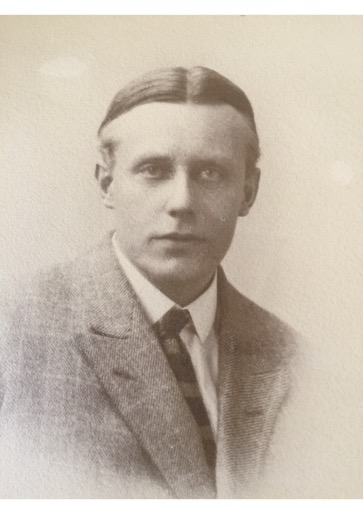
During my research, I discovered just how Noel’s independent role had enabled him to explore the technical possibilities of 35mm cameras used in extreme locations, particularly following the results achieved by Herbert Ponting in Antarctica, and adapting a similar model of Newman Sinclair camera for his own high-altitude filming. His appointment as official cinematographer to the 1922 expedition was governed by the terms laid down by the Mount Everest Committee (MEC), organisers of the expedition. The contract included Noel’s commitment to not interfere with the work of the expedition, but just record events as they happened and, most of all, not to sensationalise or ‘vulgarise’ what was regarded as a scientific endeavour. Lack of planning for the distribution of the resulting film, Climbing Mount Everest, (1922, John Noel. 35mm black-and-white, silent. 83mins.) was very frustrating for Noel.
Traditional lectures, which given by climbers on their return home, were regarded by the MEC as the most important outcome. Film screenings took second place. The expedition was not successful. Further attempts would need the finance generated by media exposure. Noel formed a company called Explorers Films, raised the sum of £8000, and negotiated control of the rights in film and photographic material produced on the subsequent expedition to Everest in 1924. This gave Noel much greater freedom to publicise the venture, which he did, in part, through the emerging and experimental use of colour film. The Natural Colour process, which had been developed by Claude Friese-Greene, had reached the stage where demonstrations could be offered to the film industry. Early in 1924, just prior to leaving for India for the Everest expedition, Noel attended a screening at the Holborn Empire where extracts using Friese-Greene’s additive process were shown. Having seen the possibilities of incorporating this in his film, Noel, somewhat impetuously, engaged the press to promote his plans. The headline ‘What Colours are at the Top of the World’ [i] appeared in the popular press and implied that the expedition to Everest would bring back a film record made in colour.
Noel now had the freedom to explore all media opportunities and to promote his involvement in the expedition. This included building a bespoke film laboratory in Darjeeling to process film. In 1922, Noel had processed his flammable nitrate film in a photographic tent at Base Camp during the expedition, drying it over a smouldering yak dung fire. In 1924, relays of porters carried the unprocessed film over one hundred miles to the Darjeeling Lab. Noel had engaged Arthur Pereira, Honorary Secretary of the Royal Photographic Society, to oversee the running of the lab and supervise the processing of his film rushes. Pereira produced a series of news items from the rushes to send to Pathe News, thus maintaining awareness of the expedition’s progress.
However, these were black-and-white, not the colour images that had been promised. There were inherent problems in the Natural Colour process, as alternate frames of the film were coloured blue-green and red to be projected at twice the normal speed to create the illusion of combined colour. The process resulted in flicker and was uncomfortable to watch. Friese-Greene’s own travelogue, The Open Road, which documented a journey by car from Land’s End to John O’Groats, which was released in 1926, illustrated such problems. The BFI digital restoration of the film in 2006 [ii] countered this by adding both colours to each frame thus improving the viewing experience considerably. Noel must have been made aware of the difficulties and later admitted to Arthur Hinks, Secretary of the MEC, ‘I took on the colour thing at the last moment’[iii]. Traditional tinting was added to sections of his final edited film to create atmosphere. However, Noel was determined to add reference to the exotic scenes witnessed on the journey and so made accurate colour records to inform his hand tinting of the many glass slides. The lantern slides (Fig. 2) were produced later using colour charts and special lantern slide water colours to introduce the appropriate colours. These coloured lantern slides proved to be extremely popular with audiences attending his lectures.
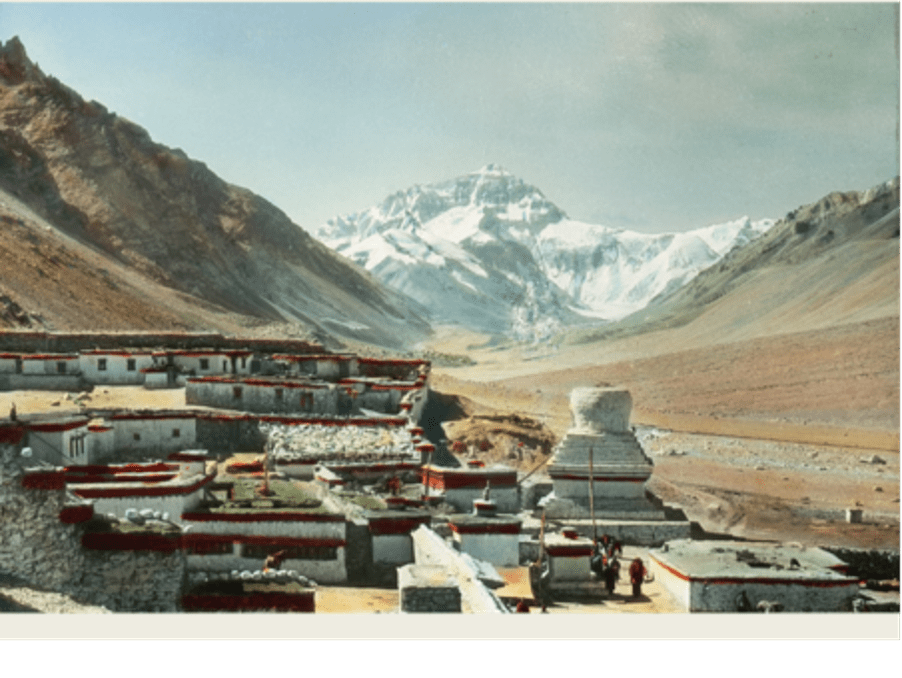
When tragedy struck and the lead climbers, George Mallory and Andrew Irvine were lost near the summit of Everest in June 1924, Noel had to change the emphasis of his film. No longer a triumphal record, he had to adapt and concentrate on the mystery of the mountain itself – ‘a “something” which would make the spectator feel the immensity of this struggle of Man against Nature’[iv]. He had booked the New Scala Theatre in London to exhibit the finished film and organised a grand theatrical spectacle: a backdrop designed by Joseph Harker set the scene and a group of Tibetan monks performed on stage before the film screening. This drew sensational press headlines with the monks treated as celebrities during the season in London and beyond when provincial and European tours followed. News of the monks’ appearances soon reached the Tibetan government – objections being raised as proper permission for the monks to leave Tibet had not been given, let alone permission to accompany the film in this way. A diplomatic controversy ensued with the Mount Everest Committee, Whitehall offices and the Government of India embroiled in what became known as ‘the Affair of the Dancing Lamas’. Fallout from this controversy resulted in permission for a return to Everest being withheld until 1933.
Noel became a persona non grata with Whitehall officials as they worked to repair relationships with the Tibetan government. His ambition to return to Mount Everest was quashed. He extricated himself from the political fallout by creating a new role on the international lecture circuits, with a particular focus on North America. In order to create content for his lectures, Hinks gave Noel permission to rework material from the 1922 and 1924 films. Noel concentrated on developing a series of lecture programmes which drew from the work of travelling showmen such as Burton Holmes and Lowell Thomas. A re-edited film The Tragedy of Everest with added narration by David Ross was released in the USA in 1931. All that remains of this title is a folded poster in the Noel papers at the Royal Geographical Society – IBG.
The next decade of Noel’s career has received little scholarly attention, yet it continues to intrigue me. My continued research into Noel’s surviving papers indicates that he partnered with a lantern colourist, Frederick Raetz for his lectures in the USA during the 1920s. A flyer suggests that they returned to the UK and jointly presented lectures about Everest. Raetz was credited for colouring the slides. Further opportunities for expeditions were explored in the USA and funding was received from Harvard for a journey to India in 1929. Reports of the 1929 expedition can be found in American press announcements, such as that published on the 8th February 1930, Lancaster, Pennsylvania as “Travel Club will make Journey to the Roof of the World”:
‘Captain John Noel has just returned from an expedition undertaken under the auspices of Harvard University and most thoroughly equipped and organised for all branches of research. The governors of our Travel Club had contacted him in advance for his illustrated story to be delivered immediately on his return and he comes to Lancaster straight from the Rochester laboratory where he has been having his films and other photographic records adjusted since landing in New York a few days ago. [v]
Further, the San Francisco Examiner, October 1930 reported that:
‘Captain Noel is widely known because of his participation in the Mt. Everest expeditions. It was following the last of these that, accompanied by Frederick Raetz, American colorist, he went to India where they spent many months living among the natives, gathering data for the lecture and filming rare scenes. All of these have been colored by Raetz’.[vi]
It is evident that, by the time of his return to the UK in the early 1930s, Noel had established a role as a travelling lecturer and showman. He undoubtedly benefitted from the expertise of Raetz in hand colouring his glass slides. The 1929 expedition had included a journey to Mount Siniolchu, the Kashmir Valley and the Taj Mahal. Many glass slides have survived but no film. Noel also developed a Colour Dissolvograph to enhance the projection of the colour slides. This received rave reviews but again these endorsements are all that survive. In a description of the Colour Dissolvograph, one advertisement states that: ‘The method of projection which is special to this particular process merges scene into scene with all the Kaledioscopic attraction that may rightly be called transformation.’[vii]
In later years, having settled in Kent, Noel continued to use his portable equipment to present benefit lectures. In 1973 the Ashford Advertiser reported that Captain Noel’s lecture on Kashmir ‘took them on a journey illustrated by entrancing colour slides … Although these were still pictures by some strange power in his story telling and inimitable photography, Captain Noel made one feel that the pictures moved with the tale’.[viii]
Throughout his long life Noel continued to investigate new technical developments, frequently contacting the BFI and pursuing opportunities to improve his images, which returns to my initial contact with him in the 1980s. Media fascination with the loss of Mallory and Irvine fostered continual reference to Noel’s films. Extracts were used in television documentaries and theatrical features, provided through the BFI Production Library. Although all extant materials are held in the national collection, Noel was fiercely protective of his rights and insisted on detailed records of the use of his materials. In his nineties, Noel continued to explore the possibility of combining his colour slides with his 1924 film. After his death in 1989, his daughter Sandra continued to monitor all media interest and I continued, as BFI contact, to provide access to material. 2013 saw the BFI’s digital restoration of The Epic of Everest, which referenced Noel’s existing original tint records. [ix]
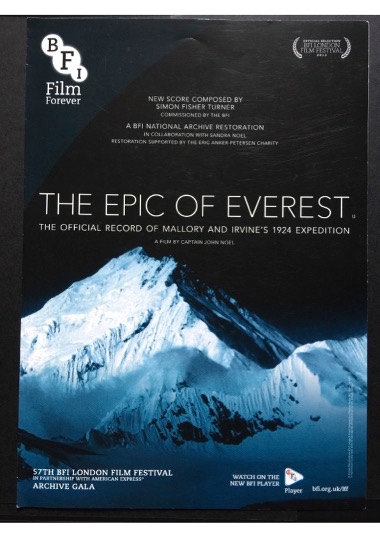
I continue to be fascinated by the quality of the hand-tinted glass lantern slides, the elusive Colour Dissolvograph and Noel’s little known 1929 expedition. As the centenary of the 1924 film approaches it is timely that Noel’s role as filmmaker, inventor and lecturer be re-assessed.
About the author: After a career as a film archivist, developing television co-productions and advising digital restorations, Jan Faull successfully completed a PhD at Royal Holloway with the Royal Geographical Society on the filming of early Everest expeditions. Dr Faull has supervised the digitisation of the Society’s film collection and has presented papers on the Everest films. She also researched early colour processes and curated a programme of Tibetan material held in the BFI National Film Archive. This specialist knowledge of a unique collection of expeditionary films was the basis of her extensive research into the Mount Everest Foundation archives at the RGS. Contact: jan.faull48@gmail.com
[i] Noel, J. B. L. (1927) Through Tibet to Everest (4th edn.1989) London: Hodder and Stoughton
[ii] The Open Road. 1926. Claude Friese-Greene (colour, silent) Edited restoration 2006. BFIVD739 64mins.
[iii] J. B. L. Noel to A. Hinks, 17th May 1924. EE 31/4/10. RGS-IBG
[iv] Sunday Pictorial 3rd February 1924. Noel Cuttings Album EE 41/6. RGS-IBG
[v] Intelligencer Journal 8th February 1930. Lancaster, Pennsylvania
[vi] San Francisco Examiner 28th October 1930
[vii ]Flyer. Noel Collection. RGS-IBG
[viii] Ashford Advertiser April 1973. Noel papers. RGS-IBG
[ix] The Epic of Everest. 1924. J.B.L. Noel (black and white, tinted, silent. 87 mins). Restoration 2013. BFIB111154
 Colour and Film